 Seamlessprotocol
 leverage tokens represented leveraged positions through ERC-20 shares
Updated -
Seamlessprotocol leverage tokens represented an ownership share in a position containing collateral and debt, using ERC-20 balances to record each holder’s interest. A configured LendingAdapter held the lending position, while a RebalanceAdapter determined eligible adjustments and acceptable position states. The LeverageManager connected those components and handled share accounting. A separate LeverageRouter added swaps and Morpho flash loans for deposits and redemptions. These relationships explained why transferring shares, changing leverage, and redeeming collateral were different operations. Seamless subsequently entered its 2026 sunset, and its former web interface went offline. The distinction between token balances and underlying lending obligations remained relevant to interpreting residual positions.
Share Ownership Across Collateral and Debt
A LeverageToken balance represented a proportional interest in the position’s equity, with its collateral and borrowing held through the LendingAdapter. Equity reflected collateral value after accounting for debt. Comparing those amounts required a common asset denomination, because the position involved a collateral asset and a debt asset. The gross collateral balance alone couldn’t describe the holder’s debt-adjusted interest.
The share balance recorded ownership without fixing the position’s asset value. A holder could retain the same share count while changes beneath those shares affected their economic value. Reading only the wallet balance left out the outstanding debt and the relative prices of the underlying assets.
The LeverageManager’s Accounting Boundary
The LeverageManager coordinated share creation, redemption, and position validation through configured adapters. It used the assets’ relative price information to oversee the position. Its deposit and mint functions received collateral and returned borrowed debt alongside shares. Direct redemption required the corresponding debt asset for repayment. Swapping belonged outside this core component, so the manager’s lending operations didn’t require one particular exchange route. An integration that needed asset conversion supplied additional execution machinery.
Lending and Rebalancing Responsibilities
The adapter interfaces divided lending-market operations from the rules that governed changes to the position.
LendingAdapter Market Access
The LendingAdapter owned the underlying collateral and debt positions and translated lending-market operations into a common interface. MorphoLendingAdapter connected that interface to Morpho’s lending markets. The adapter determined which external lending environment the token actually used; ERC-20 compatibility didn’t identify that environment. Choosing the lending connection also selected the platform dependencies that the leveraged position inherited.
RebalanceAdapter Rules
The RebalanceAdapter supplied eligibility rules and post-rebalance validation. Those checks answered different questions: whether an adjustment could begin and whether its resulting state satisfied the configured policy. A desired leverage relationship therefore required an applicable rebalance rule and executable lending actions. The token format itself didn’t specify one universal rebalance threshold or schedule.
Did ERC-20 Compatibility Include the ERC-4626 Vault Interface?
ERC-20 compatibility didn’t supply the deposit and redemption methods that ERC-4626 defines for tokenized vaults. The standards addressed different layers of functionality, even though both could involve share balances.
Balance Transfers and Approvals
ERC-20 defines balance queries, transfers, and spender approvals. For a LeverageToken, transferring shares changed their holder without itself unwinding the adapter’s lending position. The recipient acquired an interest in that same position. A transfer didn’t relocate the underlying collateral and borrowing into a new personal lending account.
Vault Entry Points and Manager Functions
ERC-4626 specifies a vault interface around a single underlying asset. The LeverageToken contract exposed share balances and conversion functions, while the LeverageManager provided the leveraged position’s entry and exit methods. Similar terminology didn’t make the interfaces interchangeable. Software expecting an ERC-4626 vault needed the appropriate interface, not merely an ERC-20 token address.
Rebalance Eligibility, Lending Actions, and Settlement
The rebalance function connected a proposed adjustment to the position’s state before and after execution. Input funding, when specified, preceded the eligibility check. The configured adapters then governed lending actions and acceptance of the resulting position.
| Rebalance Stage | Condition for Completion |
|---|---|
| Input Funding and Eligibility | The RebalanceAdapter had to accept the pre-action state and the caller after any specified input transfer. |
| Lending Actions | The LeverageManager executed the submitted actions through the position’s configured LendingAdapter. |
| State Validation and Settlement | The RebalanceAdapter had to accept the resulting state before any specified output transfer. |
| Transaction Outcome | A failed eligibility or state check reverted the rebalance transaction. |
The acceptance rule belonged to the configured RebalanceAdapter. Its successful check established compliance with that rule during the transaction; subsequent market conditions could change the position again.
What Did the LeverageRouter Add to the Manager?
The LeverageRouter combined asset swaps and Morpho flash loans with the manager’s deposit and redemption functions. This immutable periphery contract supplied execution capabilities beyond the manager’s accounting role.
The deposit route distinguished the sender’s collateral contribution from total collateral added to the position. The latter also included collateral obtained by swapping flash-borrowed debt assets. Borrowing against the enlarged position supplied debt assets for flash-loan repayment.
The redemption route used flash-borrowed debt assets to meet the repayment requirement for the shares being redeemed. Part of the released collateral supported the swap needed to repay that flash loan. The collateral remaining after execution formed the collateral output.
The
redeem()
path accepted a MulticallExecutor and caller-supplied swap calls. The executor ran those calls sequentially and swept specified remaining tokens back to the router. Approval and swap calls had separate roles, making their targets and calldata part of execution. A separate
redeemWithVelora()
path delegated its debt purchase to a VeloraAdapter and returned remaining collateral. These interfaces accepted different parameters, so an integration needed the call format for its selected method.
Separate Base and Ethereum mainnet deployments had their own contract addresses. Base used chain ID 8453; Ethereum mainnet used chain ID 1. An integration had to match the token, manager, router, and any selected executor or adapter on that network.
Preview Amounts and Minimum-Output Controls
Action previews exposed different units, while minimum-output parameters constrained what an execution could accept.
Collateral, Debt, and Shares
The router’s deposit preview distinguished total collateral, borrowed debt, and issued shares. For a leveraged deposit, total collateral included the leveraged portion, so it wasn’t simply the sender’s initial contribution. Those fields described different assets or ownership units. Treating the debt field as an additional unencumbered return would misread the borrowing that financed the position.
Action Fees and Management Accrual
The preview’s
tokenFee
and
treasuryFee
fields expressed fee amounts in shares. Token action fees accrued to remaining holders’ share value; treasury action fees accrued to the configured treasury. A nonzero management fee introduced a separate time-dependent effect. FeeManager accrued it linearly using elapsed time and total share supply. Charging a positive accrued amount minted treasury shares, and the manager included accrued fee shares in its supply for share-value conversions. An unchanged wallet balance therefore didn’t establish an unchanged ownership fraction. These share quantities also needed separate accounting from collateral-denominated swap costs.
Share and Swap Floors
The router used
minShares
for deposit share protection and
minCollateralForSender
for the sender’s redemption collateral floor. An output below the applicable share or collateral floor reverted the transaction. Swap calls needed their own slippage constraints. A minimum share output couldn’t replace a minimum swap output, because the checks constrained different parts of execution. Fresh swap quotes mattered because quoted conditions could change before submission.
Could Fixed Adapter References Point to Upgradeable Code?
Fixed adapter references could point to upgradeable implementations in the documented architecture. The manager’s stored adapter selection and the code executing at an adapter address were separate properties.
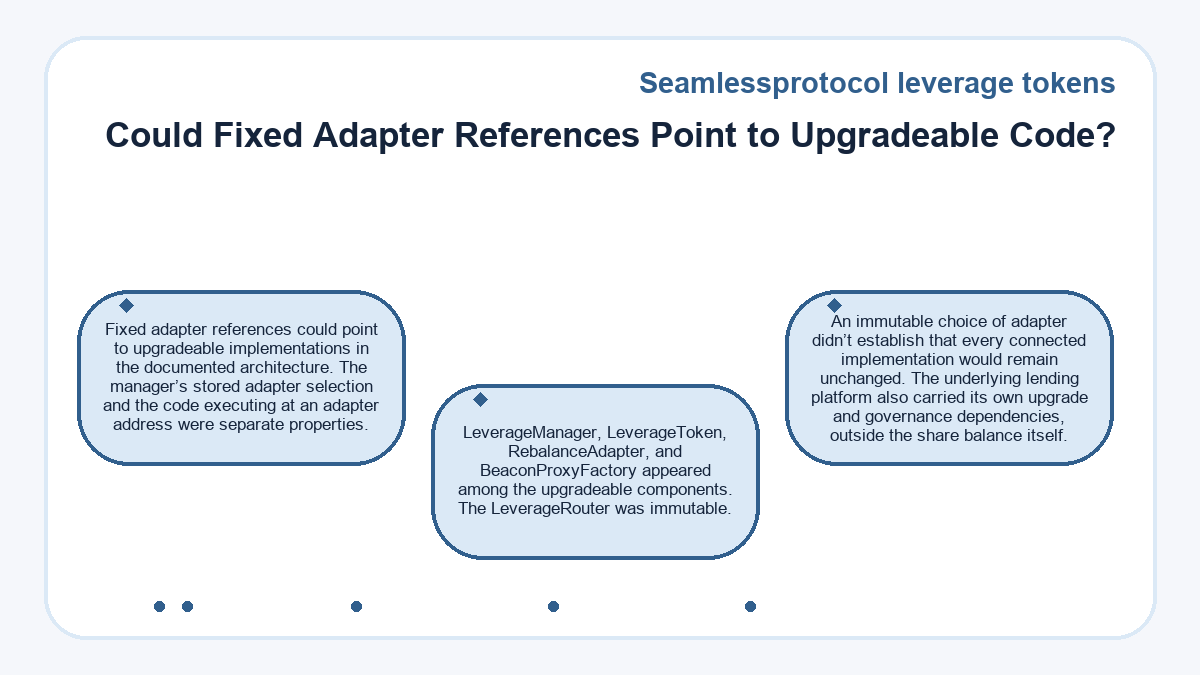
LeverageManager, LeverageToken, RebalanceAdapter, and BeaconProxyFactory appeared among the upgradeable components. The LeverageRouter was immutable. An immutable choice of adapter didn’t establish that every connected implementation would remain unchanged. The underlying lending platform also carried its own upgrade and governance dependencies, outside the share balance itself.
Permissionless Creation and Token Identity
Permissionless creation allowed external deployers to configure new LeverageTokens without a token-creation allowlist. That openness also permitted deceptive configurations. A familiar name or an ERC-20 interface didn’t establish a benign lending connection. The position’s identity included its network, token contract, collateral and debt assets, and configured adapters.
Underlying Market and Oracle Dependencies
Each leverage token inherited technical and economic risks from the platforms reached through its adapters. Oracle failures, smart contract bugs, insolvency, and governance attacks could affect the position’s safety or value. A rebalance policy operated within those platform conditions. Passing its state checks didn’t eliminate the dependencies that made collateral valuation and debt repayment possible.
Market access also qualified the execution route. A flash loan needed an available debt source, and a collateral-to-debt swap needed an executable quote. Removing collateral depended on the connected lending market’s behavior and liquidity.
The 2026 Sunset and Residual Positions
Leverage Tokens belonged to a different product generation from the legacy ILM v1 strategies that wound down in 2025. That earlier closure didn’t establish the later token system’s shutdown date. Seamless DAO reported that its web interface went offline on July 1, 2026. The interface closure didn’t establish that every share balance had redeemed or every underlying debt had disappeared. A remaining position’s exit depended on its deployed contracts, outstanding obligations, and available lending-market liquidity.
Practical questions about Seamlessprotocol leverage tokens
-
Which Token Approval Did a LeverageRouter Redemption Require?
- A router redemption required approval for the router to spend the LeverageToken shares being redeemed. The approval concerned the share token, while a deposit’s collateral approval concerned a different token. An approval authorized spending; it didn’t itself redeem shares or repay the position’s debt.
-
Why Could a Router Deposit Fail After Its Swap Completed?
- A router deposit still had to satisfy its minimum share output and repay the Morpho flash loan. The newly funded position could return less borrowed debt than the router owed. If the router lacked sufficient debt assets for repayment, Morpho’s repayment transfer failed and the transaction reverted. Completing a swap didn’t establish completion of the whole deposit.
-
How Did an Empty LeverageToken Obtain Its Initial Collateral Ratio?
- The configured RebalanceAdapter supplied the initial collateral ratio when the token’s total share supply was zero. That initialization rule allowed different configurations to define their own starting relationship between collateral and debt. It didn’t establish one ratio for every token or require an existing position to restart from its initial ratio after every subsequent deposit.
-
What Did Each MulticallExecutor Call Contain?
- Each MulticallExecutor call contained a target address, an ETH value, and encoded calldata. The value field specified native ETH attached to that call; it wasn’t the quantity of collateral or debt tokens being swapped. Token approvals and swaps used their own encoded function arguments. The executor processed the supplied calls sequentially within the router’s execution.
-
Where Did Surplus Debt From a Router Deposit Go?
- A successful router deposit returned debt assets exceeding its flash-loan repayment requirement to the caller. A wallet calling directly received that surplus itself. When an integration contract called the router, that contract received the assets, and its forwarding logic determined their onward transfer. The router didn’t independently select the wallet that had initiated an integration contract’s call.
-
Could a Successful Simulation Guarantee That a Later Transaction Would Succeed?
- A successful simulation didn’t guarantee execution under later blockchain conditions. It evaluated the supplied call against the state used for that simulation. A changed swap quote, lending position, or available liquidity could change the subsequent outcome. The transaction still had to satisfy its actual contract checks and output floors when executed.
-
Why Could Raw Share Balances Differ From a wallet’s Displayed Amount?
- A wallet’s display applied the token’s decimals metadata to its raw integer balance. That formatting converted base units into a readable token quantity. It didn’t convert shares into collateral, subtract the position’s debt, or calculate redemption proceeds. Share formatting and the manager’s asset conversion served different purposes, even when an interface displayed both as ordinary numbers.